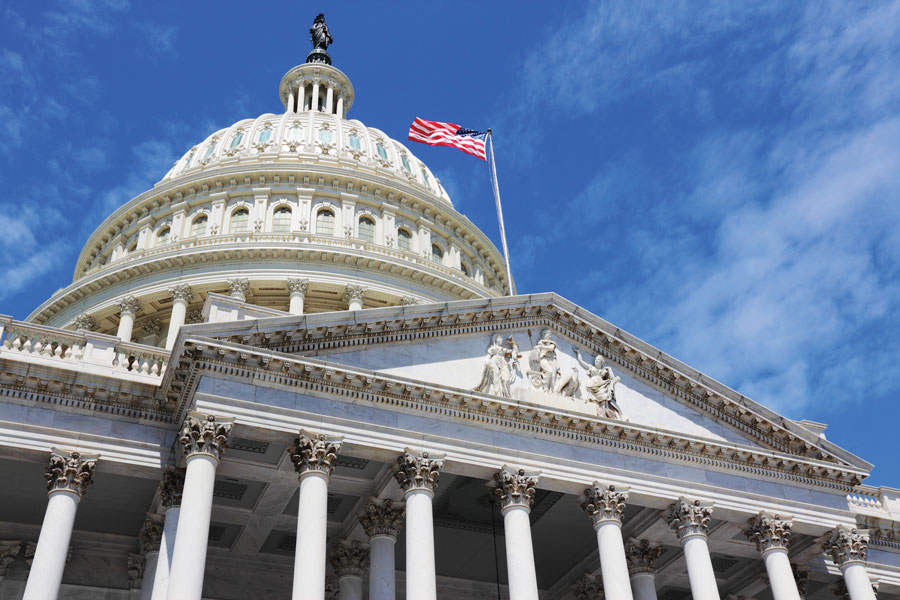
The US Senate on Thursday unanimously passed a rule barring its members from trading on prediction markets, following a wave of legislative proposals and enforcement actions targeting the fast-growing industry.
The vote came one day after Sen. Bernie Moreno, Republican of Ohio, introduced a resolution that would amend the Senate's standing rules to prohibit members from entering into any contract or transaction "dependent on the occurrence, nonoccurrence, or the extent of the occurrence of a specific event" – language broad enough to cover the full range of contracts available on platforms like Kalshi, Polymarket, and PredictIt.
As reported by Cleveland.com and other outlets, Moreno said: "Any Senator who comes to Washington, D.C., to cash in, play the markets, or treat public office like a side hustle is a betrayal to the people they swore to serve." He added that using elected office for personal financial gain is "a clear abuse of power."
The unanimous action at the Senate Thursday, first reported by CNBC, arrives against a backdrop of mounting legal and regulatory pressure on prediction markets. Earlier this month, Kalshi announced it had suspended and fined three congressional candidates – one running for the Senate and two for the House – for trading on contracts tied to their own races.
The following day, the Department of Justice announced the arrest of Army Special Forces Master Sgt. Gannon Van Dyke, who now stands accused of using classified information about the US military mission that captured Venezuelan leader Nicolás Maduro to place bets on Polymarket. Van Dyke allegedly netted nearly $410,000 on those trades.
Acting Attorney General Todd Blanche acknowledged the novelty of the situation in a statement following the arrest. "Widespread access to prediction markets is a relatively new phenomenon," he said, "but federal laws protecting national security information fully apply."
Also on Thursday, a group of Democratic lawmakers called on the Commodity Futures Trading Commission to issue a rule blocking insider trading and corruption in prediction markets and banning event contracts tied to elections, military actions, sports, and government decisions that lack a valid economic hedging purpose.
The legislative activity reflects a broader, bipartisan unease about how prediction markets interact with political power and privileged information. Sens. John Curtis of Utah, Adam Schiff of California, and Catherine Cortez Masto of Nevada previously introduced the Prediction Markets are Gambling Act, which would prohibit companies from offering contracts on sporting events, athletic competitions, and casino-style games.
Curtis said the bill was intentionally limited in scope. "My other co-sponsors and I were not really trying to solve all of the problems with predictive markets," he said. "We're narrowing in on a slice of it with this bill."
He also pointed to what he sees as broader social costs. "Anybody who looks at gambling knows it's a regressive tax," Curtis said, "and so the impact of us not controlling this is far more detrimental."
The concern is not without statistical grounding. A survey by the Siena Research Institute and St. Bonaventure University found that 27% of Americans now hold active accounts on online prediction market platforms.
Read more: Prediction markets on track for $1 trillion by 2030, but sports betting stirs legal storm
Congressional researchers have also flagged suspicious trading patterns. A legal analysis published this month noted a sharp spike in large purchases of contracts predicting US military strikes on Iran shortly before those strikes occurred in February, raising questions about whether traders had advance knowledge.
CNN separately reported that one Polymarket trader has made nearly $1 million since 2024 by placing prescient bets on when the US and Israel would launch military strikes against Iran.
A companion bill, the Public Integrity in Financial Prediction Markets Act of 2026, would specifically bar government officials from using nonpublic information to trade prediction contracts. Curtis and Schiff are also co-sponsoring that legislation, along with Sens. Elissa Slotkin of Michigan and Todd Young of Indiana.
Curtis suggested the current slate of bills is only the beginning. "What you're going to see from the Senate is not a short list of bills dealing with these markets," he said. "It's very clear to my colleagues and me that this is important, that we jump on quickly."

Getting a client into a fund has never been easier – but after that, the hardest part is yet to come.

A former NYLIFE Securities rep was permanently barred after using internet-enabled glasses to cheat on the Series 6 exam

Both of Vanguard's acquisitions have targeted the RIA industry, but the first ended in a legal settlement just weeks before buying Altruist.

Chris Davitt and Anupam Singh bring institutional recruiting muscle to a firm built for advisors chasing equity and independence.

Appointment continues a wave of AI leadership hires reshaping wealth management as advisory firms race to build out digital and data infrastructure.
Northern Trust’s Ken Lassner shows advisors how to convert volatility into after-tax portfolio gains
Dan Biagini of American Equity says the steady decline of pensions, longer lifespans and a reset in interest rates are rewriting how advisors build retirement income